
I know that loneliness and social isolation is prevalent amongst the bereaved community
I’ve been a therapist for 23 years this year and spent most of that in the NHS but now I work part time at the University in Occupational Therapy Teaching and Research and part time freelance for myself delivering therapy in the community.I was approached by a local organisation, a local forest school who, asked me if they could commission me to run a trauma informed project and what that project could be was very loose really so I was free to kind of define what that would look like. I designed a nature based bereavement project which I started running in March 2024.
I chose to look at bereavement because I worked for some years in palliative care in North Tyneside and then went on to study at PhD level paediatric palliative care, and some further study into childhood bereavement and how to support children with loss. So, it’s a passion of mine really, supporting people with loss.
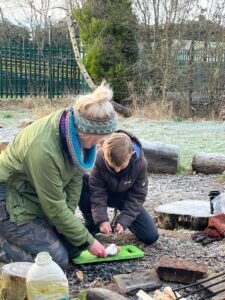 I’ve ran 4 of those adult projects so far and what I found was that I wanted to deliver to children also, but I knew I wanted to deliver the children one to one or in sibling pairs. But the adults, I wanted to deliver those as part of a group because I feel that, or I know that, loneliness and social isolation is prevalent amongst the bereaved community.
So, it felt that delivering in a group format would help with this sense of developing community around people experiencing loss. And then what ended up happening from there really was that the adults that I was working with in the group projects wanted me to see their children. So it ended up becoming quite a family systemic approach really where there were times that I’d be working with a parent and then at the same time but on a different day, working with their child and that produced a really lovely sense of cohesion all round.
I set up a family drop in which occurred once a month or still does occur. And that is a place where the adults that I’ve been working with and their children that I’ve been working with, we can congregate once a month on a Sunday morning. It’s informal but it means that adults that ’ve been working with get to meet other adults that I’ve been working with on different projects. It brings this kind of multi-layer of bringing adults together that hadn’t previously been involved but have a common experience and bringing children together that haven’t met each other previously but were similarly in similar situations. Children that had lost a parent or children that had lost a grandparent they were very close to and for them, for the children in particular the kind of normalising of, ”So you’re in the same thing, you understand, okay.” I think that was really helpful for the children.
Cath Darling was interviewed in 2025 as part of the Trees of Hope project.