
This memory was written by Harry in about 2005 and is read by his daughter Jeanette in 2025.
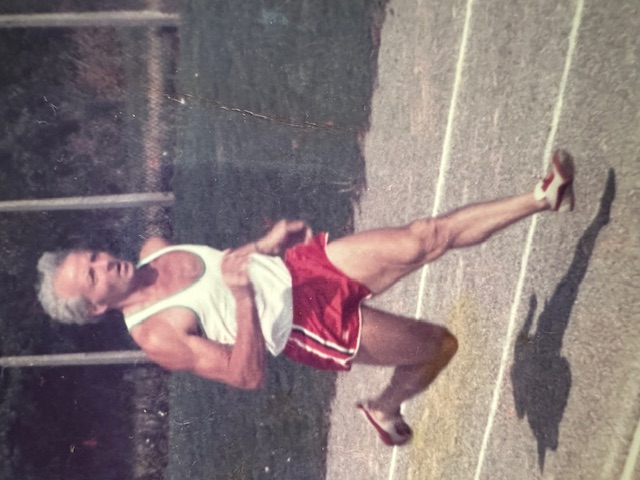 I was born 1934 in a very small mining village in Northumberland and this is where I became a professional sprinter. The village had two football teams 14 to 16 and 16 to 18 years. I started playing for the 14 to 16, not that I had great talent with a football, but I had a natural talent to run and could kick a football with either foot, something England is very short of these days! I played on either the wing or centre forward, but having other talented footballers playing alongside you made all the difference; they would do all the fancy footwork and then at the precise time would play the ball just in front of me and I was off like a jackrabbit. As I recall, the local miners who supported us on a Saturday would shout, “Set the winger away” to tell the player to pass the ball to me and no matter who the defender was he was not going to catch me.
The speed I could run with a pair of heavy leather football boots on had not gone unnoticed. Two gentlemen approached me one day shortly after a game and asked if I would like to become a professional sprinter. “What do I have to do for that?” I asked. “We will train you 2 days a week and enter you in the handicap races, but you’ll have to start on a low handicap mark. When you build it up you stand a better chance of winning races.” I spoke to my dad about this and he said, “You might as well give it a try”.
These two gentlemen had no knowledge of coaching athletes, neither were there any courses they could attend in order to become coaches. Their method was plain and simple. I would practice starts and running sets of 20 yds, 40 yds and 60 yds together with the other young lads that they also trained. When I look back, I had just started an engineering apprenticeship with the National Coal Board at the age of 15, that meant working for a period on various workshops. I started in the blacksmith shop, starting work at 7.30am until 4.30pm with only half an hour for lunch, no morning or afternoon breaks then. As you can imagine my legs got very tired as I had to stand all day beside a hot furnace and swing a 14lb hammer on an anvil, but I still managed to train three days a week both for running and football. My mother had a hell of a job to get me out of bed at 6.30 in the morning.
The following year I moved up into the 16 to 18 year football team. My football skills had developed slightly but my running with a football had greatly improved. I ran in quite a lot of handicap races but never won a final. My trainers would put lead weights into my running shoes so it would look as if I was trying very hard, but the handicapper knew all the tricks. This is just one of the tricks in professional sprinting and there are lots more.
Once a year most of the mining villages would have a Gala day for the children of the village and a professional running handicap would take place at the same time. There would be brass bands, people would be in fancy dress and at one end of the field you could hear the bookmakers shouting out the betting prices for the runners in the handicap races. The lanes would be marked off with string threaded through steel spikes, about a foot high in the ground, as in the film Chariots of Fire.
I had just turned 18 years old and my dad thought it was time he found someone else to train me. A very good friend who worked with my father down the pit said his son was a very good sprinter and it would be beneficial for us both to train together. So, my dad and his friend started to train us. My dad also played football for the same village when he was young, so he had some experience of keeping fit and I dare not say I was tired. After several weeks of training with my new partner I began to feel very fit and was running extremely well. My partner who was also a good runner could not keep up with me even over 60 yards and so I had to give him a 2 yards start in order to retain the speed over distance.
The year was 1953, I was 18 when my father decided it was time to try to win a handicap race. My handicap mark had been steadily increasing and I was stronger and faster. The handicap we decided to try and win was held in Cramlington village, only 5 miles from my village. My dad said he’d been saving up and would buy me a new pair of running spikes made to measure. These were made of very fine kid leather and cost £7, a lot of money in those days. I was earning about 35 shillings a week. When I first tried running with these new spikes on it felt as if I had nothing on my feet.
I can still recall the way I felt on the morning of that race. I thought I could jump over a five-barred gate without touching it. As I warmed up I could hear the bookmakers shouting the betting odds for the runners in my heat. By this time I had butterflies in my stomach and a very dry mouth. I just wanted to get started.
As I mentioned before, there were tricks in professional sprinting and here is another one. Some of the men that I worked with were at the race and they wanted to know if I was trying to win that day so that they could place a bet on me. All I said was, “If I’m going to try for a win I’ll blow my nose going to the start”. I did as promised and won my heat very easily. The semi-final was a much harder race because 3 of the 8 runners had good handicap marks and I was giving them 3 to 4 yards start out of 80 yards. However, the way I felt on that day made no difference, I still won the race.
The bookmakers were offering the odds of 3 sometimes 4 to 1 that I would not win the final. Starting blocks were not allowed in professional running so by this time I had just about mastered the art of starting. Now something strange was about to happen. As I jogged back down the track to run in the final, the starter was loading his gun. He said, “You have a good runner sitting in the next lane and you are giving him half a yard start”. “Who is it?” I asked. “It’s Ray Wood who plays in goal for Manchester United”. At that point, and this is another trick in professional running, I said to the starter, “I will need a quick one today”. This means when the starter shouts GET SET, he fires the gun almost immediately giving you the advantage of a very quick start.
As we went to our marks the bookmakers stopped shouting and the crowds went silent. I was feeling very nervous and tried to concentrate on the race, GET SET BANG almost within a few yards I was level with Ray Wood and we held that position until 2 yards from the tape when I threw myself forward to breast the tape and won the race. The prize was £40 to the winner and I could not believe I had won that amount of money.
I had to go into a large marquee to collect my prize money. I was so nervous I was unable to count the money because I had never seen that amount before. Ray Wood, who was standing next to me, shook my hand and congratulated me. I think I was on cloud 9 as I walked out of the marquee.
I have taken you through what I would call the apprenticeship of professional running. There was lot to learn about this game, for example, starting too quick before the gun fired in order to get pulled back half a yard; running as hard as you can for 50 yards then easing off so you were almost last and as I mentioned carrying lead in your running shoes and around your waist like a belt. The handicapper would at some stage put a good runner in a race that he knew he could win but if you did you were giving him the measure of your fitness. So you would do one of the above, maybe two.
I got married when I was 22 years old and the older men at work said, “That’s your running days over”. Well, I proved them wrong. I started playing amateur football but instead of running locally I concentrated on running in the Scottish border games. Places like Kelso, Jedburgh, Selkirk, Peebles and lots more, all held the Scottish border games. The prize money was bigger and there was lots more going on, things like tossing the caber, wrestling, highland dancing and they also included the 200, 400 and 800 yds. The biggest was the Jedburgh games with the prize money of £100. You may have heard of Powderhall which is held in Edinburgh, the biggest professional handicap of them all, held every New Year’s Day. The prize money then was £180 to the winner and whatever else you won on betting. Now it is a sponsored race with prize money in excess of £1,000.
I think the pinnacle of my professional career came in 1962 when I was 28 years old. I was quoted as the favourite by the bookmakers at long odds to win Powderhall but I was beaten in a very close finish by a runner whose handicap was 4 yards in front of me. That was 10 weeks of hard winter training lost, but that’s athletics, you win some you lose some.
I finally gave up professional running in 1970 and joined Gosforth Harriers Athletics Club. My running career then became a mixture of sprinting and middle-distance running. Gosforth Harriers celebrated their 50 year Golden Jubilee 1927-1977. The history of the club was compiled in a special book for that occasion In their records of sprinters they wrote the following:
‘In terms of veteran championship medals, Harry Crane is the most successful club vet having won the Northern Vets 200m in a world record ranking time of 23.8 seconds and being placed 2nd in the 100m in 1975, finishing 2nd in both events in 1976.’
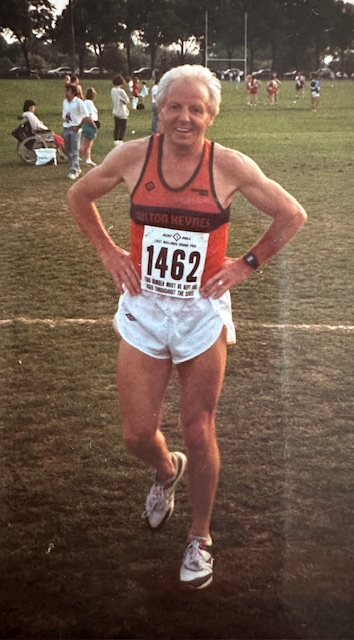 Looking back, I can honestly say that I have had and enjoyed a very successful running career. I suppose I have taken part in almost every race I can think of from 100 yds to a marathon. I took part in the very the first London Marathon and the very first Great North Run, happy days.
My professional best records times were:
100yds – 10.2s
200yds – 21.8s
As an amateur:
100m – 11s
200m – 23.8
400m – 57.8 which was a club veteran record not beaten until 2005.
I often think, like most other runners, what I would have achieved if we’d had all the scientific knowledge of training athletes then that we have today, but we will never know.
Just keep fit as long as you can and most of all enjoy life, it’s the only one you have!
Harry Crane